

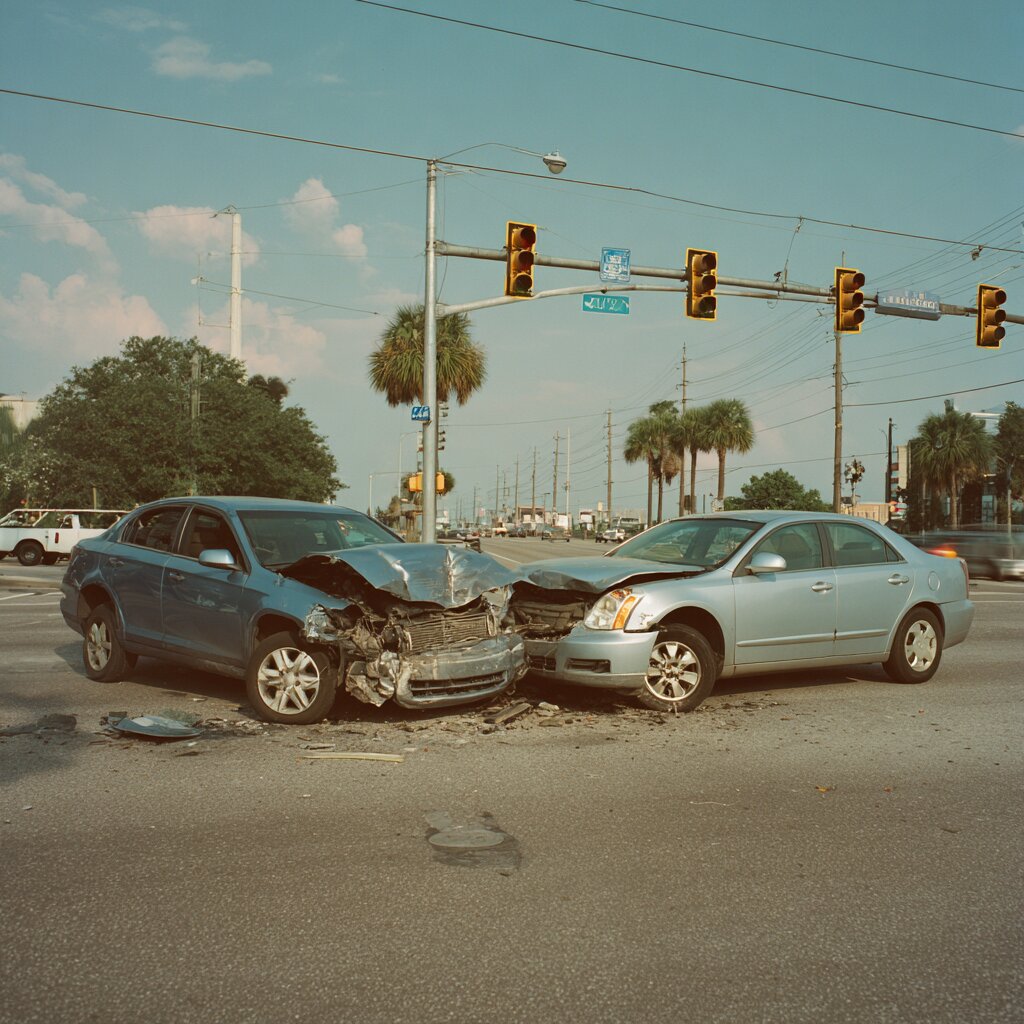
Key evidence in Mississippi car accident claims includes the official police report, photos of the accident scene, eyewitness testimony, video footage from dashcams or traffic cameras, physical damage to cars, medical records related to the injuries you sustained, and documentation of lost wages from work.
Proving fault means showing exactly how the other driver acted negligently and caused your crash. Mississippi uses pure comparative negligence, which reduces your compensation by your percentage of fault. Strong fault evidence protects the full value of your claim.
Key Evidence To Gather After a Car Accident in Mississippi
Police Reports and Crash Records
A police report is an official document created by law enforcement after your accident. The responding officer records important details like the date, time, location, weather conditions, and statements from drivers and witnesses.
Police reports also include diagrams of the accident scene and note any traffic citations issued. While these reports may not be admissible in court as evidence, they provide a crucial foundation for insurance investigations and settlement negotiations.
Photos and Video From the Scene
Pictures and videos taken immediately after your accident create a permanent record of what happened. These images capture details that disappear quickly, like vehicle positions, skid marks, debris, and road conditions.
You should photograph all vehicle damage, visible injuries, traffic signs, and the overall accident scene from multiple angles. This visual evidence often tells a clear story of how the crash occurred and who was at fault.
Eyewitness Testimony That Moves the Needle
Witness testimony in Mississippi car accident claims can be extremely powerful evidence. Independent witnesses have no connection to either driver, making their testimony more credible and persuasive.
Mississippi follows one-party consent law for recordings. This means you can legally record conversations you participate in without telling the other person. You can use this law to record witness statements at the accident scene.
Electronic Data and Dashcam Footage
Modern vehicles contain electronic evidence that can prove fault in your accident. Event Data Recorders (EDRs) are “black boxes” that record vehicle speed, braking, and steering input moments before a crash.
Dashcam footage provides real-time video of exactly how your accident happened. Don’t forget about other video sources like doorbell cameras from nearby homes or surveillance systems from local businesses.
Vehicle Damage Patterns and Skid Marks
Physical damage to vehicles tells experts important details about your accident. The location and severity of damage reveals impact angles, collision force, and vehicle speeds.
Skid marks on the pavement show braking patterns and can help determine how fast vehicles were traveling. Accident reconstruction experts analyze this physical evidence to determine fault and recreate the sequence of events.
Evidence That Proves Injuries and Losses
Mississippi law requires proof of actual damages before you can recover compensation. Your evidence must clearly link your injuries and losses to the accident, separating them from any pre-existing medical conditions.
Medical Records and Bills
Seeking immediate medical attention after a car accident in Mississippi is critical for your health and creates an official record of your injuries. This medical documentation becomes essential evidence in your claim.
Key medical evidence includes:
- Emergency room records: Document your immediate injuries and treatment
- Doctor’s treatment notes: Show ongoing medical care and recovery progress
- Diagnostic test results: X-rays, MRIs, and CT scans prove injury severity
- Physical therapy records: Demonstrate rehabilitation needs and progress
- Prescription receipts: Show medication costs related to your injuries
Lost Wages and Earning Capacity
If your injuries prevent you from working, you can claim compensation for lost income. Lost wages refer to money you’ve already missed from work, while loss of earning capacity covers future income you’ll lose due to permanent disabilities.
You’ll need documentation like pay stubs, tax returns, and employer letters confirming your salary and missed work time, as these are critical settlement value factors in your claim. Self-employed individuals should gather profit and loss statements to prove their income losses.
Pain and Suffering Documentation
A pain journal is a daily record of your physical pain and emotional suffering after the accident. Write specific descriptions like “sharp stabbing pain in my lower back prevents me from sleeping” rather than vague statements like “my back hurts.”
Include any mental health treatment you receive for anxiety, depression, or trauma related to your crash. These records help prove the full impact of your accident beyond just medical bills.
Property Damage and Repair Estimates
Document all damage to your vehicle and personal property inside it. Gather repair estimates from body shops, total loss valuations if your car is destroyed, and rental car receipts while yours is being fixed.
Severe vehicle damage can actually support your injury claims by showing the force of impact in your accident.
Why Evidence Matters in Mississippi Claims
Evidence is proof that shows who caused your car accident and what damages you suffered. In Mississippi, you must have strong evidence to win compensation because the state follows a fault-based system. This means the driver who caused the crash pays for all damages.
Without solid evidence, insurance companies will deny your claim or offer you far less money than you deserve. Your evidence needs to prove three key things:
- Fault: Who caused the accident through negligent driving
- Damages: Your financial losses like medical bills and lost wages
- Causation: Your injuries came directly from this specific crash
Strong evidence protects you from insurance company tactics and ensures you get fair compensation for your losses.
What Must You Prove in a Mississippi Car Accident Claim
Mississippi law requires you to prove four specific elements to win your case. Think of these as building blocks, if one is missing, your entire claim can collapse.
Duty of care means every driver must operate their vehicle safely and follow traffic laws. This is a legal obligation all drivers have to protect others on the road.
Breach of duty occurs when a driver violates their duty of care. This happens when someone speeds, texts while driving, runs red lights, or breaks any traffic law.
Causation connects the other driver’s bad behavior directly to your accident and injuries. You must show their negligent actions caused the crash that hurt you.
Damages are your actual losses from the accident. These include medical expenses, lost income, property damage, and pain and suffering you can document with bills and records.
How to Gather and Preserve Evidence After a Crash
Evidence disappears quickly after car accidents. Surveillance footage gets erased, witnesses move away, and physical evidence at the scene is cleaned up. You must act fast to preserve crucial proof for your claim.
Steps at the Scene
If you’re physically able, take these actions immediately after your accident:
- Call 911 to get police officers to the scene for an official report
- Take photos and videos of the accident scene from multiple angles
- Get names and phone numbers from witnesses who saw what happened
- Exchange only basic insurance information with the other driver
- Avoid admitting fault, apologizing, or saying you feel fine
Steps in the Days After
Your evidence gathering continues long after you leave the accident scene:
- See a doctor for a complete medical evaluation even if you feel okay
- Request copies of all medical records and bills from every healthcare provider
- Start keeping a daily pain journal documenting your recovery
- Report the accident to your insurance company with basic facts only
- Stay completely off social media until your case is resolved
Preservation Letters and Subpoenas
A preservation letter is a formal legal demand sent to companies or individuals requiring them to save specific evidence. Attorneys send these to trucking companies for driver logs or to businesses for security camera footage.
A subpoena is a court order that legally compels someone to turn over evidence if they refuse to comply with a preservation letter.
Getting Traffic and Security Camera Footage
Surveillance footage is often overwritten or deleted after a short time, so act quickly to preserve any video evidence.
Potential video sources include:
- City traffic cameras: Contact your local municipality’s traffic department
- Business surveillance: Gas stations, stores, and restaurants near the accident
- Doorbell cameras: Homes in neighborhoods where the crash occurred
- Bank ATM cameras: Financial institutions often have exterior security systems
Which Mississippi Laws Affect Evidence and Fault
Several Mississippi-specific laws directly impact how evidence is used and how fault is determined in your car accident claim. Understanding these rules helps you navigate the legal process and protect your rights.
Pure Comparative Negligence in Mississippi
Pure comparative negligence is Mississippi’s system for assigning fault in accidents. This means you can still recover compensation even if you’re partially at fault, but your award is reduced by your percentage of blame.
Under Mississippi’s pure comparative negligence rule, any compensation you recover will be reduced by your share of fault, so a partially at-fault driver receives less than the full damages. This makes evidence of fault percentages extremely important for maximizing your compensation.
Three Year Lawsuit Deadline
Mississippi’s statute of limitations gives you three years from your accident date to file a personal injury lawsuit. This is your absolute deadline – miss it and you lose your right to compensation forever.
Some exceptions exist for minors or government claims, but evidence becomes much harder to find as time passes. Acting quickly protects your ability to build a strong case.
Are Police Reports Admissible in Mississippi
Police reports are generally considered hearsay and aren’t automatically admissible as evidence in Mississippi courts. However, the officer who wrote the report can testify about what they personally observed at your accident scene.
These reports remain highly valuable during insurance investigations and settlement negotiations even if they can’t be used directly in court.
One Party Consent to Record Witnesses
Mississippi is a one-party consent state for recording conversations. This means you can legally record any conversation you participate in without telling the other people involved.
You can use this law to record witness statements at the accident scene, but be careful not to record private conversations between other people.
What Evidence-Killing Mistakes Should You Avoid
Even strong evidence can be destroyed by common mistakes that accident victims make. Insurance companies actively look for these errors to justify denying claims or reducing settlements.
Vehicle Repairs Before Inspection
Repairing or scrapping your vehicle before the other driver’s insurance company inspects it can eliminate crucial physical evidence. The damage location and severity are key parts of the fault investigation.
While storage fees can be expensive, preserving this evidence is more important for protecting your claim’s value.
Social Media Posts That Backfire
Insurance adjusters will search your social media profiles as one of many insurance company tactics to devalue car accident claims. Photos of you at parties can contradict injury claims, while posts discussing the accident can be twisted into admissions of fault.
The safest approach is avoiding social media entirely until your case is completely resolved.
Recorded Statements to Insurance
The other driver’s insurance company will call requesting a recorded statement about your accident. You have no legal obligation to provide one, and doing so almost always hurts your case.
The adjuster’s goal is getting you to say something they can use to minimize your injuries or leave you blamed for a car accident that wasn’t your fault.
Never make these mistakes when dealing with insurance companies:
- Never guess about accident details you don’t clearly remember
- Never downplay your injuries by saying “I’m fine” or “it’s not that bad”
- Never accept quick settlement offers without consulting an attorney
- Never sign broad medical authorizations for the opposing insurance company
How Maloney-Lyons Builds Your Evidence File
At Maloney-Lyons Personal Injury & Car Accident Lawyers, we understand that strong evidence wins cases. David J. Maloney and T. Randall Lyons personally handle every case from start to finish, ensuring you get experienced attorney attention rather than being passed off to junior staff.
Immediate Investigation and Scene Work
We act quickly to preserve evidence before it disappears forever. Our attorneys visit accident scenes to photograph conditions, measure skid marks, and interview witnesses while their memories remain fresh.
With offices in Mobile and Biloxi, our experienced Biloxi car accident lawyers can respond rapidly across Mississippi to begin building your case immediately.
Expert Witnesses and Reconstruction
Complex cases often require expert witness testimony to explain technical evidence to insurance companies and juries. We work with trusted networks of specialists including accident reconstructionists who analyze crash dynamics, medical experts who explain injury severity, and economic experts who calculate future lost income.
These professionals help translate complex evidence into clear explanations that support your claim for maximum compensation.
Managing Medical Proof and Liens
Healthcare providers and insurance companies often place medical liens on your settlement. A medical lien is a legal claim for repayment of treatment costs from your recovery.
Our attorneys negotiate these liens down to maximize the money you actually receive. We also help coordinate medical treatment for clients without health insurance coverage.
Skilled Auto Accident Law Firm in Biloxi, Mississippi
Evidence begins disappearing immediately after your accident while insurance companies start building cases against you. You must act quickly to protect your rights and preserve crucial proof for your claim.
Maloney-Lyons Personal Injury & Car Accident Lawyers offers free consultations to evaluate your evidence and explain your legal options. We represent clients across Mississippi, Alabama, Florida, and Georgia with compassionate counsel and aggressive representation.
We handle all cases on contingency fees, meaning you pay nothing unless we win your case. Contact our law firm today so we can handle the legal complexities while you focus on recovering from your injuries.
FAQs About Evidence in Mississippi Car Accident Claims
Can I Use Dashcam or Doorbell Footage to Prove Fault in Mississippi?
Yes, dashcam and doorbell camera footage is admissible evidence in Mississippi courts and can provide powerful, objective proof of exactly how your accident happened.
How Long Do Businesses Keep Traffic or Security Camera Video?
Surveillance and traffic-camera footage is often kept only briefly, so you should act immediately to preserve this evidence.
Can I Record a Witness Without Telling Them in Mississippi?
Mississippi follows one-party consent law, meaning you can legally record any conversation you participate in without informing the other person.
How Do I Get Black Box Data After a Car Crash?
Your attorney can send a preservation letter to prevent destruction of Event Data Recorder information and then obtain this data through legal discovery or subpoenas.
Do I Need to Keep My Totaled Car for Evidence?
Yes, preserve your vehicle until all insurance companies and experts complete their inspections, as repairs or disposal can eliminate crucial physical evidence of the crash.
Should I Give a Recorded Statement to the Other Driver’s Insurance?
No, you have no legal obligation to provide recorded statements to the other driver’s insurance company, and doing so typically harms your claim.
What Documents Prove Lost Wages in Mississippi?
Pay stubs, employer letters confirming your salary and missed work time, and tax returns prove lost wages, while vocational expert testimony may be needed for future earning capacity claims.
What Is the Hardest Type of Injury to Prove After an Accident?
Soft tissue injuries like whiplash and psychological trauma like PTSD are hardest to prove because they don’t appear on X-rays and lack visible external symptoms.


